The faces of Pamir: the mountain lived, inhabited, spoken
This colloquium takes place on Wednesday, April 8, 2026 from 8:30am-8:30pm at Inalco, PLC (65, rue des Grands Moulins, Paris 13e) - PLC Auditorium.
Entrance is free (subject to availability) and takes place face-to-face.
Colloquium rationale
The colloquium takes as its starting point a reflection on the singularity and diversity of an exceptional territory: that of the Pamir, a mountain range located at the crossroads of five international borders (Afghanistan, Tajikistan, Pakistan, China and Kyrgyzstan). The aim is to understand the Pamir as an actor in history, a world-space in its own right, inspired by the Braudelian approach to the Mediterranean Sea, and to emphasize different temporalities. Going beyond traditional political divisions, this scientific meeting aims to highlight the geographical, cultural and social specificities of this cross-border space, as well as the wealth of human and linguistic dynamics that animate it.
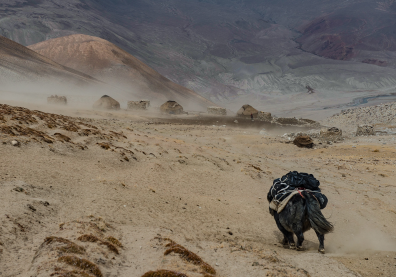
While the Pamir remains largely absent from the French academic paysag, it is arousing growing interest among European researchers and those from the region, who are producing an abundant, transdisciplinary literature. The Pamir is also awakening interest in landscapes and lifestyles that have long attracted travellers, explorers, mountaineers, writers and film-makers. The image will also be examined as an indexical vector of this region and its specificities that remain little shown.
The Pamir also intrigues by its languages. The history of the study of the so-called Pamir languages is rich, beginning in the second half of the 19th century with the first publications on Shughni, Wakhi, Sarikoli, etc.
The preservation of these languages, which are mainly transmitted orally, constitutes a subject of importance but also of conflict
This symposium thus proposes to take stock of current research in the social sciences and linguistics on this region still too often reduced to its historical role in the "Great Game" or to its contemporary geostrategic dynamics. By bringing together specialists from different disciplines on Pamir for the first time in France, this meeting aims to refocus attention on the realities experienced by Pamir's inhabitants, through an approach attentive to the practices, languages, mobilities and forms of resilience that shape their daily lives.
Conference program
- 8:30am-9am: Welcoming the Public with coffee
- Tour of the exhibition "Imagining the Border" by Tobias Marschall and photographs of the Pamirs by Marc Brédif
- 9am-9:30am: Colloquium presentation - Introductory words
- Sophie Hohmann (Inalco, CREE),
- Agnès Korn(CNRS, CERMI),
- Mélanie Sadozaï (University of Regensburg, Germany)
9:30am-1:15pm: The Pamir as seen by the social sciences
9:30am-10:45am: Written and oral sources: telling, mapping, drawing the Pamir
Moderation:Jean-Baptiste Georges-Picot (EHESS, CRCAO)
- Francis Richard (orientalist, documentalist): Books and manuscripts in the Pamirs, a very special tradition
Markus Hauser (freelance cartographer): Mapping the Pamir's Past: Stories from the Pamir ArchiveLaurianne Bruneau (archaeologist, EPHE): Status of work on the Pamir Gilgit Complex
10:45am-12pm: Beyond isolation: mobilities, contacts and circulations
Moderation: Sophie Hohmann (Inalco, CREE)
- Mélanie Sadozaï (politiste, University of Regensburg): The Tem cross-border market: a symbol of effervescence and connectivity between Tajikistan and Afghanistan
- Tobias Marschall(anthropologist, Geneva Graduate Institute): Temporalities crossed: A road crosses the wandering lines of the Afghan Pamirs
- Suzy Blondin (geographer, University of Lausanne): Isolation feared, isolation desired: understanding im/mobilities in the Bartang
12:00-13:15: Capturing the Pamir: music, cinema, narratives
Moderation: Stéphane Sawas (Inalco, CERLOM)
- Leila Dodykhudoeva (linguist): Holy places of Badakhshan: name and cultural resonance
- Benjamin Joguet (ethnomusicologist, Université Nanterre): From the cradle to the coffin. Life to the rhythm of parting songs in Upper Badakhshan
- Ariane Zevaco (anthropologist, CETOBaC, CREM-LESC, Institut Convergences Migrations and filmmaker): Studying representations of Tajik Pamir on ethnographic, cinematographic and musical stages: political and artistic issues
13:15-14:30: Lunch break
14:30-18:00: Pamir as seen through linguistics
14:30-15:45: Panorama of the languages of Pamir and their neighbors
Moderation: Agnès Korn (CNRS, CERMI)
- Henrik Liljegren (linguist, Stockholm University): Areality and language contact in the Greater Hindu Kush
- Oleg Belyaev & Artyom Badeev (linguists): News from the field: The Bartangui language and its position in the Shughni-Rushan group
Aleksandr Sergienko (linguist, Université Paris Cité) & Daria Chistiakova (linguist, Université de Liège): Alignment shift in Bartangi
3:45pm-5pm: Preservation of languages and their heritage
Moderation: Matteo De Chiara (Inalco, CERMI)
- Clinton Parker (linguist, Nazarbayev University, Kazakhstan): Gender in Shughni
- Kirill Fessenko (linguist, University of Berlin): Remarks on the reflexes of the root *kanH 'to dig' in East-Iranian languages
- Beate Reinhold (linguist, Hamburg): Not High Mountaindwellers anymore, yet still Wakhi: Wakhi speakers living abroad and their discourses on a common language and tradition for future generations
5pm-6pm: Coffee break around the presentation of children's books in Pamir languages byLeila Dodykhudoeva and online lexicographic materials, Yury Makarov (linguist, University of Cambridge, UK)
18h-18h30: Closing of the symposium
- Xavier Bernier (geographer, Sorbonne University): A reflection around the mountain
19h-20h30: Screening & Debate
Screening of the documentaries Bridging the Divide, by Aliaa Remtilla (Canada, 2013, 40 mn) and Ganj, by Mehrubon Malikov (Tajikistan, 2019, 27 mn) and followed by a debate moderated by Ariane Zévaco, in the remote presence of the director Aliaa Remtilla.
Bridging the Divide,by Aliaa Remtilla.
Bridging the Divide follows the journey of anthropologist Aliaa Remtilla and her adopted Tajik father, Shirinbek, on a trip across the border into Afghanistan. This is Shirinbek's first visit to this Afghan village, which is nevertheless visible from his home in Badakhshan, Tajikistan. In the course of his visit, he meets relatives he knew existed, but had never met before. Following Shirinbek's journey, Bridging the Divide explores how human beings can become bridges, capable of building bonds based on shared humanity, without erasing the social and political differences that continue to separate them.
Ganj (Treasure), by Mehrubon Malikov.
Through a creative film that blends fiction and documentary, director Mehrubon Malikov questions how music lies at the heart of life in Pamir, from birth to death. Is music as a philosophy of life disappearing?
Organization
- Sophie Hohmann (INALCO, CREE)
- Agnes Korn (CNRS, CERMI)
- Mélanie Sadozaï (University of Regensburg, CREE)