Short Programmes, Broad Horizons: Three Intensive Programmes Bring EUniWell to Inalco
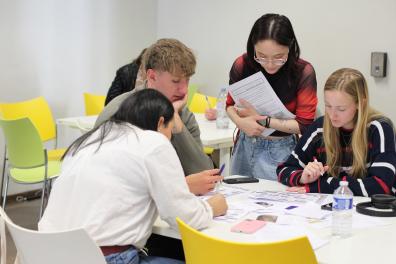
These intensive programmes offered participants a rich academic, intercultural and human experience. Through seminars, workshops, hands-on learning activities and cultural visits, students were able to engage with major contemporary issues while discovering Inalco’s academic environment and the diversity of its approaches.
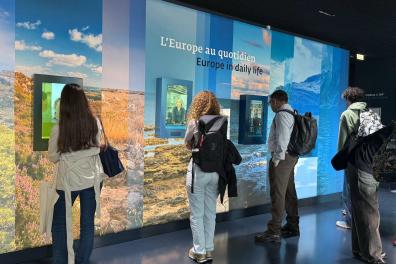
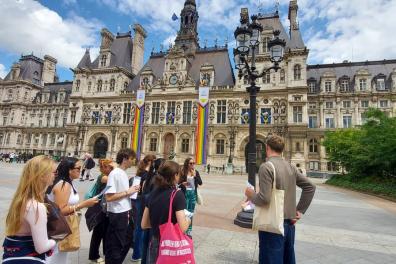
The first programme, dedicated to French language and culture, immersed students in French society, history and cultural practices. Combining language classes, workshops, educational treasure hunts, guided museum visits and walks through Parisian neighbourhoods, it offered a lively and concrete introduction to the French linguistic and cultural context.
The second programme focused on migration dynamics in the Mediterranean, a topic closely aligned with Inalco’s contribution to EUniWell. Coordinated by Andreas Guidi, EUniWell Champion at Inalco, it brought together students and academics to explore the historical, political, social and cultural dimensions of mobility, borders and migrant experiences across the Mediterranean.
The summer school on the European Union’s external action invited participants to reflect in depth on the EU’s role in the world, its policy instruments, strategic priorities and relations with different geopolitical regions. Through a multidisciplinary approach, students gained insight into the major challenges shaping European foreign policy today.
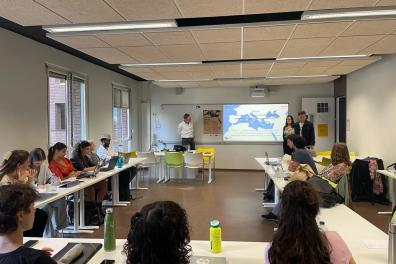
Together, these three short programmes helped strengthen ties between Inalco and its EUniWell partners, while showcasing the scientific and academic networks developed within the alliance. The exchanges were enhanced by contributions from several scholars from partner universities, including María del Mar Grandío Pérez, EUniWell Champion at the University of Murcia; Christoph Lange and Nina ter Laan, members of the Mediterranean Liminalities network at the University of Cologne; and Manuel Borutta, from the University of Konstanz.
Alongside these programmes, Inalco also hosted an inter-campus seminar led by Carmen Widera and Georg Kaiser, two scholars from the University of Konstanz, who were accompanied by 13 students. They delivered a series of workshops and lectures on linguistics and multilingualism in France.
Through these initiatives, Inalco reaffirms its role as a hub for academic, intercultural and European dialogue. These programmes highlight the institution’s ability to design innovative, internationally oriented learning formats that connect directly with the major issues of our time.