Marina Lisa Komiya's "Senjo no Hito" wins the Inalco student prize for manga 2026
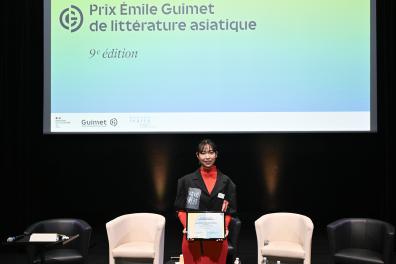
The Emile Guimet Prize for Asian Literature
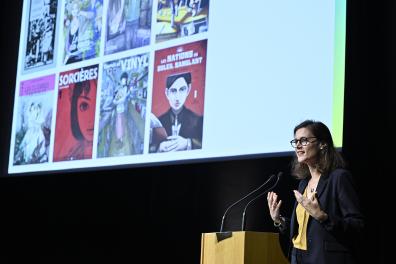
Launched by the Musée Guimet in 2017, the Émile Guimet Prize for Asian Literature honors the original work of an author from Asia, recently translated and published in France. It aims to promote contemporary Asian literature and encourage cultural exchanges between Asia and France. Since 2024, in addition to the Novel category created in 2017, the Émile Guimet Prize for Asian Literature also crowns a work in the Comics category. Since 2025, the Guimet Museum has joined forces with Inalco to create the Inalco Student Prize for Manga. This prize recognizes a manga by an author, published in Japan and translated into French.
The manga category
The Inalco student prize for manga recognizes a manga published in Japan and translated into French, as well as a special mention. The prize aims to reward a voice and a vision that make a significant contribution to Japanese comics, while helping to promote auteur manga and introduce this vast universe to France.
Its jury is made up of five Inalco students from different study departments.
Winners of the 9th edition
🏆 Novel prize: "Salamalecs" by Antonythasan Jesuthasan, translated from Tamil by Léticia Ibanez (éditions Zulma).
🏆 Comics prize: "Les légendes des steppes" by Ajnai, translated from Chinese by Daphné Huang (éditions Paquet).
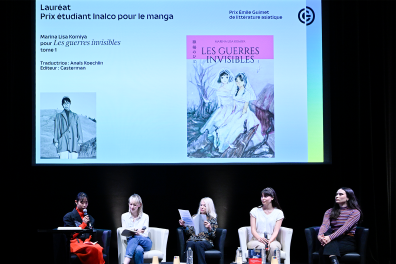
🏆 Inalco student prize for manga: "Senjo no Hito", volume 1 by Marina Lisa Komiya, translated from Japanese by Anaïs Koechlin (éditions Casterman).
"Senjo no Hito" wins Inalco student prize for manga
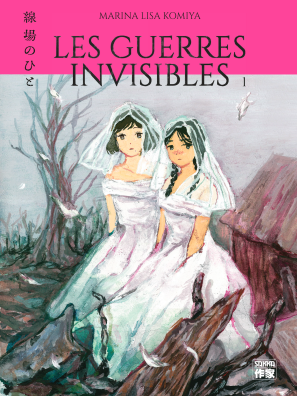
Among the 8 mangas selected, the students chose to reward "Les Guerres invisibles", volume 1 by Marina Lisa Komiya, translated from Japanese by Anaïs Koechlin and published by Casterman (Sakka collection).
Jury statement
The jury chose to reward a work singular in its narrative and graphic treatment. "Les guerres invisibles" tackles contemporary conflicts from a human, political and intimate angle. The pace is masterful and the pictorial metaphors aptly serve the complexity of emotions. The place of women and minorities in post-war Japan invites readers to question the world around them, and the duty of remembrance that concerns us all. Wars don't end with the armistice, as the title of the work reminds us.
Summary
At the end of the Second World War, in a Tokyo in ruins and occupied by the American army, the time is ripe for survival and reconstruction. But for some, forced to keep quiet about who they are, the battles are still raging.
An intimate and flamboyant drama, "The Invisible Wars" is the story of four people discriminated against for their nationality, sexual orientation, origins or identity. From Japan to the USA, they meet, love, lose and wait for each other in the folds of history.
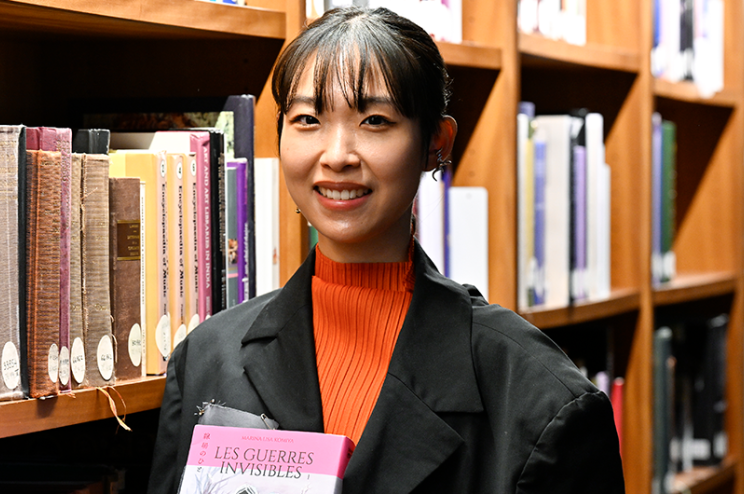
A non-binary artist of Japanese-American culture, Marina Lisa Komiya was born in 1992 in the United States and lives in Japan. They graduated from the prestigious Joshibi University of Art and Design. Queer themes are at the heart of their work. They explore them through multiple media: installations, videos, performances and manga. Senjo no Hito was distinguished in Japan in the 2025 edition of the annual benchmark ranking Kono Manga ga sugoi.
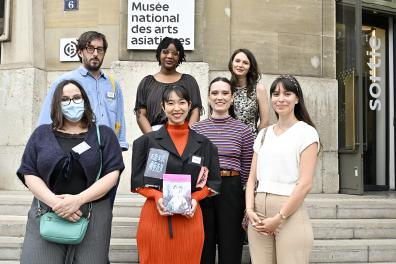
Prior to the awards ceremony, four students on the jury had the opportunity to enjoy a privileged moment with Marina Lisa Komiya to discuss the winning work, in the presence of her translator Anaïs Koechlin, also an alumna of Inalco, editor Wladimir Labaere, in charge of the Sakka collection at Casterman Editions, and translator-interpreter Caroline Alexandre.
The students presented their respective backgrounds, shared their impressions of the winning manga and exchanged views with its author. They also interviewed Wladimir Labaere and Anaïs Koechkin about the manga market in France, as well as the publishing and translation professions in this sector.

Jury's special mention
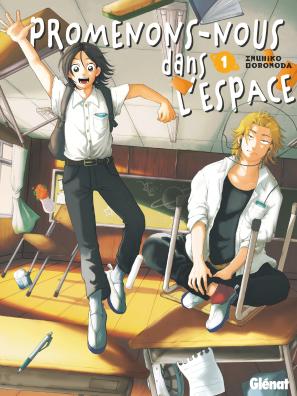
The five members of the jury also wished to award a special mention to volume 1 of the manga Spacewalking with You by Inuhiko Doronoda (éditions Glénat), translated from Japanese by Karine Rupp Stanko.
Jury's Laudatio
This manga features high school students (Keisuke Uno and Yamato Kobayashi) who are seemingly opposites, but share similar difficulties in their daily lives. Through their journeys, the story tackles themes such as difference, understanding oneself and others, and tolerance. The jury wanted to reward a work of rare gentleness: neurodiversity is shown without being named and without cliché. The male friendship that emerges is tender and free of any toxic masculinity. With the lightness of a slice-of-life manga, the work offers a beautiful representation for those who perhaps don't always feel they belong.
Summary
Struggling at school for years, Yamato Kobayashi puts on a bad-boy air and takes on a string of odd jobs outside school hours, never lasting the test of time. Until the day Keisuke Uno is transferred to his class...
Panicked when spoken to too insistently, unable to multitask, this unusual high-school student struggles to cope with the more "normal" aspects of everyday life, but hangs on thanks to a multitude of tricks that keep him going. Kobayashi, who recognizes himself in Uno, then tries to follow his example... in an attempt to move forward with his own difficulties.
Inuhiko Doronoda is a Japanese mangaka. She won the Manga Taishô 2024 prize and the Kono Manga ga Sugoi 2025 prize for her first manga series "Promenons-nous dans l'espace", launched in Japan in 2023 on Kôdansha publishing's &Sofa site.