A look back at the "Dragons visit Inalco" conference
This article was written by Monya, a third-year LLCER Chinese degree student.
Art historian and Inalco lecturer Lia Wei took us on a journey through a few millennia of material culture, tracing the history of the dragon from the late Neolithic to the Han dynasty. Her presentation began with a shell mosaic depicting a dragon and a tiger, moved on to jade masks and ornaments, and ended with bronzes and steppe ornaments decorated with composite creatures. These works testify to the adaptation of the dragon or composite creature to various ritual and symbolic contexts. Thus, the transmission of these motifs is not linear or continuous: jades, bronzes and other prestige objects have been reused and reinterpreted over the centuries, across a vast territory whose borders play a central role in the construction of visual identities.
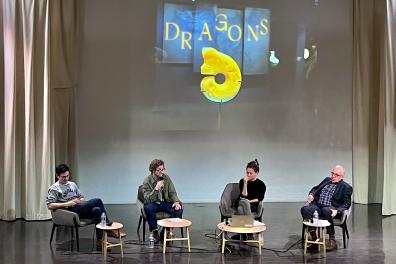
The pre-modern literature specialist and professor at Inalco Vincent Durand-Dastès explored the role of dragons in legends and popular culture. In particular, he evoked tales of Emperor Taizong's confrontation with the dragon king of the Jingle River. He qualified the exhibition by showing how dragons can be protective, but also malevolent, and closely linked to popular cults. In contemporary China, the figure of the dragon remains alive in animated cinema and visual culture, and the debate focused in particular on the relevance of using the term " long " to distinguish the Chinese dragon from its Western version.
Returning to the exhibition itinerary
Julien Rousseau, chief heritage curator and head of the Asia collections at the musée du quai Branly - Jacques Chirac, and Adrien Bossard, director of the Departmental Museum of Asian Arts in Nice, presented several major pieces from the exhibition.
The tour began with a dragon-pig preserved at the National Palace Museum in Taipei. A hybrid creature, it is a snake with a pig's snout, considered the mythical ancestor of the Chinese dragon. Placed at the opening of the exhibition, this piece introduced the archaic and symbolic forms of the dragon.
The tour continued with two exceptional calligraphies, also on loan from the National Palace Museum, expressing different ways of representing the dragon and its claws. The curved characters, whose strokes evoke the sinuous shape of the creature, are adorned at their ends with hooks.
Finally, an imperial official's robe completed this presentation. It is embroidered with five-clawed dragons on a mountainous landscape background. An auspicious sign, it symbolizes imperial power. This exceptional piece demonstrates the technical refinement of the dragon's symbolic power in Chinese art. The robe is both a decorative object and a bearer of ritual and political meaning.
This conference has thus highlighted the richness and complexity of dragon representations, revealing a figure in constant transformation, at the crossroads of art, power and the imaginary, from Antiquity to contemporary China.
.