Survey nature in the Japan of Edo: The illustrated album of materia medica (1828) by Iwasaki Kan'en
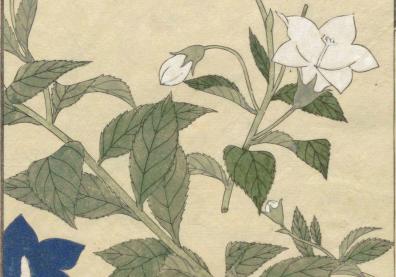
The Illustrated album of materia medica (Honzō zufu), completed in 1828 by Iwasaki Kan'en, is a major work of natural history in Japan. With its 92 fascicles listing nearly 2,000 plant species, it is the first large-scale flora entirely in color. It falls within the field of honzō (ch. bencao), a form of knowledge of Chinese origin devoted to natural substances used in medicine, which flourished during the Edo period thanks to the development of commercial publishing and private academies. If the Bencao gangmu (Classification raisonnée de la materia medica, 1596) by Li Shizhen serves as a frame of reference for Japanese naturalists, they are quickly confronted with the challenge of its adaptation to the archipelago: hence the effort, from the end of the 17th century, to inventory the local fauna and flora and refine the classifications. At the same time, botanical illustration develops, stimulated by the enthusiasm for horticulture and the vogue of naturalistic themes in painting, while the Western influence becomes more tangible at the turn of the 19th century, notably through exchanges with European scholars. Born in Edo, Iwasaki Kan'en bases his work on direct observation, horticultural practice and the compilation of Japanese, Chinese and Western sources. Between 1830 and 1844, he made thirty copies of his work, entirely hand-painted and intended for high-ranking advisors, wealthy lords and naturalistic doctors. The exceptional quality of the plates—in colour and sometimes double-page — demonstrates a clear desire: to facilitate the identification of plants with a precision unprecedented at the time.
With:
Nicolas Mollard (Inalco/Ifrae)
Mathias Hayek (EPHE)
Organizer:
Juliette Genevaz (U. Lyon 3/Ifrae) View e-mail