Education policies in China and Taiwan: making grades, making elites
Siyu LI, Senior Lecturer, Aix-Marseille University
"The gaokao as a production chain: measurement infrastructures and the transformation of schools into "exam factories"
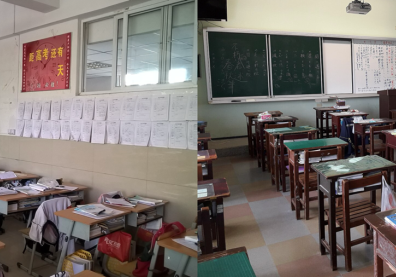
This presentation will analyze the gradual transformation of Chinese schools into veritable "exam factories" under the effect of the digitization of the marking process for the gaokao 高考, the national entrance exam for higher education.
Based on multi-site ethnographic material, she will show how digitization, scanning and standardized grading systems are reorganizing establishments around a just-in-time production logic. And how the introduction of measurement infrastructures, such as digital scoring platforms, redistributes professional roles, reduces teacher autonomy and intensifies forms of internal surveillance. Alongside the fact that these technologies reinforce inequalities between establishments according to their ability to master the material and cognitive infrastructure of examinations.
By taking a close look at the making of grades, this presentation will uncover the socio-technical and political mechanisms that underpin the apparent objectivity of the gaokao, and interrogate the tensions between justice, efficiency and control in contemporary regimes of educational quantification.
Ting-Huang TAI, PhD in Sociology, Institut des sciences sociales du politique (ENS Paris-Saclay)
"Educating scientific elites? Construction of educational policies aimed at intellectually precocious high school students in Taiwan"
The status and meaning of gifted and talented education varies considerably between educational systems. In Taiwan, the term gifted and talented was translated into Mandarin as tzu-fu yu-yi 資賦優異 and defined in a law enacted in 1984. The term refers to children with either "exceptional potential" or "remarkable academic results", thus covering the idea of high potential and that of its academic realization.
To understand why the education of intellectually precocious children (EIP) constitutes a school offering that is both prestigious and contested in the Taiwanese context, this presentation will look at its institutionalization, mobilizing archives, interviews with teachers and school statistics.
In the first instance, the analysis will show that the educational policy for IPEs is successively based on several principles of justification. And secondly, that the EIP class constitutes an elitist and selective stream within Taiwanese secondary education, due to demographic, academic, curricular and institutional factors. This double analysis, genetic and systemic, will help to grasp the distinctive position of this stream in a national educational system.
Distance participation possible.
Contact the organizers:
Christian GALAN View e-mail
Marine DEPLECHIN View e-mail