Building the Future of Online Teaching for Lesser-Used Languages: LULaC Training in Cologne
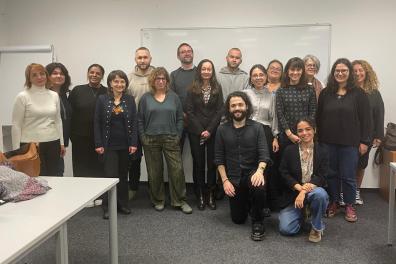
From 27 to 30 October 2025, fourteen teachers and project managers from the University of Cologne, the University of Florence, the Taras Shevchenko University of Kyiv and Inalco gathered in Cologne for a training on digital language teaching, organised as part of the Erasmus+ project Lesser-Used Languages Classroom (LULaC).
This training marked a new milestone in the project, which aims to promote language diversity in higher education by harmonising and digitising the teaching of lesser-used languages. Following a year of collaborative work developing CEFR-based teaching content for Turkish and Ukrainian, participants are now preparing to design asynchronous online courses for each language. These courses will be made available on the ILIAS digital learning platform of the European alliance EUniWell, of which the four LULaC partner universities are members.
Hosted by the University of Cologne with contributions from professors from Inalco and the University of Strasbourg, the four-day session combined pedagogical reflection with technical training on ILIAS. Participants developed key skills in digital course conception, such as planning and structuring online modules, managing collaborative workflows, and creating interactive and learner-centred activities.
Beyond skill-building, the training strengthened cooperation among project partners and reaffirmed LULaC’s commitment to supporting multilingualism and digital innovation in language education across Europe.
Funded by the European Union. The views and opinions expressed are those of the authors and do not necessarily reflect those of the European Union or the French National Erasmus+ Agency. They do not engage the responsibility of the European Union or the granting authority.