Short courses for executives and managers
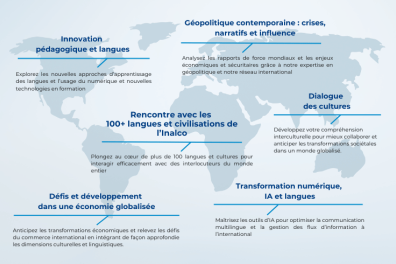
INALCO’s range of training programmes for decision-makers is organised into six main categories to address contemporary challenges.
Executive Education programmes by topic
Please feel free to contact us at View e-mail to find out the dates of our next sessions and discuss your needs and requirements.
An introduction to the 100+ languages and civilisations at INALCO
A unique immersion in over 100 languages and cultures, enabling professionals to better understand and interact with people from all over the world.
Reading, understanding and analysing the Chinese press: getting to grips with information at source
3 days | please contact us
Reading, understanding and analysing the Chinese press: getting to grips with information at source
3 days | please contact us
China is now one of the most influential economic powers, whose growth and technological ambitions are disrupting the international balance of power. Regularly making headlines due to its strategic position on the global stage, it exerts a decisive influence on trade, diplomacy and geopolitical relations. Against this backdrop, any professional wishing to access direct sources in Chinese must be able to interpret the written media beyond a simple word-for-word translation, by understanding the implied meanings and nuances that truly shape the message. This course therefore offers targeted support to help participants acquire the essential skills for reading and understanding the Chinese press.
Aimed at those wishing to consolidate their linguistic and technical skills, this course focuses on everyday vocabulary, the specific characteristics of Chinese print media, speed-reading techniques, the selection and summarisation of relevant information, and accurate translation.
Perspectives on Ukraine: understanding, communicating, collaborating
29 hours | please contact us
Perspectives on Ukraine: understanding, communicating, collaborating
29 hours | please contact us
The training course ‘Perspectives on Ukraine: understanding, communicating, collaborating’ arose from the need to support the growing number of international actors and organisations currently operating in Ukraine or working with the Ukrainian population, against a backdrop of escalating conflict since 2022. An increasing number of public and quasi-public bodies, NGOs, development agencies, businesses and institutional partners are working on projects relating to reconstruction, humanitarian aid, the reception and support of refugees, as well as diplomatic and defence missions.
In this context, it is essential to possess a cultural, historical and linguistic understanding in order to interact effectively with the Ukrainian population and successfully carry out collaborations or initiatives both on the ground and in France. This training course meets these needs by offering an approach that is both cultural (historical, sociological and geopolitical aspects) and linguistic (an introduction to the Cyrillic alphabet, basic vocabulary and sentence structures, and professional vocabulary). It provides participants with the necessary foundations to engage in dialogue, negotiate or simply communicate in a respectful and appropriate manner, whilst taking into account cultural specificities and the sensitivities of the current context.
Tailor-made language training
Duration depending on your objectives | subject to quotation
Tailor-made language training
Duration depending on your objectives | subject to quotation
INALCO (National Institute of Oriental Languages and Civilisations), drawing on its extensive expertise, offers courses in over 100 Oriental languages. Whether group, one-to-one, bespoke or in-house courses, there is a programme to suit your needs.
Learning a language at INALCO means not only acquiring essential linguistic skills but also discovering the cultural and historical characteristics of the regions studied.
This course is aimed at anyone wishing to discover or develop their knowledge of a language. To ensure effective and lasting skills development, we tailor the content, delivery methods and duration of the course to your objectives. (Inalco Executive Education does not offer language courses in French, English or Spanish)
Training course: Preparing for life abroad
3 days | please contact us
Training course: Preparing for life abroad
3 days | please contact us
This training programme is aimed at all professionals and their families who are set to live and work in a foreign country for an extended period. It offers comprehensive support combining an exploration of the cultural and historical characteristics of the host region, the learning of essential language skills, and guidance on a range of practical matters (accommodation, schooling, healthcare, cultural and sporting activities, etc.).
Going beyond a simple introduction, the course aims above all to give participants and their families the confidence they need to make the most of their expatriate experience. It helps them to understand cultural norms, anticipate potential risks and build meaningful relationships with their future contacts, partners and colleagues. Thanks to a variety of resources (written materials, case studies, targeted bibliographies and web resources, and dedicated MOOCs for certain languages), each learner can deepen or consolidate their knowledge independently.
Our expat preparation programmes provide the keys to a successful expatriate experience by helping participants understand the cultural and organisational challenges of the host country, whilst encouraging the development of a strong local network. It thus provides an essential foundation for adapting quickly, both professionally and personally, and for making the most of your time abroad. View the course in detail
Country or Region Briefing Training
3 or 4 hours | please contact us
Country or Region Briefing Training
3 or 4 hours | please contact us
This bespoke training programme is designed to equip professionals who are due to take up a post abroad for a variable period of time with in-depth and immediately applicable knowledge. It enables them to gain a thorough understanding of the cultural, political and economic realities of their country or region of assignment, ensuring a smooth integration and an immediate impact on their assignments.
Thanks to the specialised and multidisciplinary expertise of our lecturers, each programme is designed to address the strategic challenges and specific responsibilities of the participants. Our team of lecturers, researchers and practitioners brings in-depth knowledge of the relevant languages and civilisations, as well as solid experience in geopolitical analysis and intercultural communication.
We tailor all course content, delivery methods (face-to-face, online or blended) and duration to meet individual objectives and organisational constraints as closely as possible. This bespoke approach ensures the development of practical skills, greater confidence in tackling complex issues, and the ability to represent one’s institution or company effectively on the international stage.
Educational innovation and languages
At the forefront of research into language teaching and educational design, our courses explore new teaching approaches, language learning in the digital age and the use of artificial intelligence to optimise the transfer of knowledge.
Teaching the Chinese language: supporting learning with new technologies
3 days – 2026 | please contact us – 2026
Teaching the Chinese language: supporting learning with new technologies
3 days – 2026 | please contact us – 2026
Mandarin Chinese is renowned for the complexity of its writing system, which is based on characters, and for its spoken form, characterised by the use of tones. Between memorising vocabulary, mastering pronunciation and tackling grammar, learning this language can be a real challenge for learners.
To meet this challenge, this training course offers a pragmatic and innovative approach to teaching Chinese as a foreign language. Participants will learn to design teaching programmes tailored to the varied needs of teenage and adult learners, whilst incorporating new technologies and the creation of digital resources into the development and delivery of their lessons to optimise learning and sustain everyone’s motivation.
Dialogue between cultures
In a globalised world, the ability to navigate intercultural interactions is a major asset. Our training programmes offer a multidisciplinary approach to better understand societies, foster dialogue and anticipate societal change.
Generation Z and Intercultural Understanding: Understanding the codes and developing
tailored marketing strategies
1 day | please contact us
Generation Z and Intercultural Understanding: Understanding the codes and developing
tailored marketing strategies
1 day | please contact us
Generation Z, which is ultra-connected and set to thrive in a global environment, is challenging traditional approaches to communication and marketing. Their defining characteristics – a quest for authenticity, predominantly digital interactions, and a focus on inclusivity and civic engagement – are expressed through particularly dynamic subcultures (fashion, music, wellness routines, activism, etc.).
For organisations wishing to develop or adapt their strategies on an international scale, it is now essential to take these new reference points and the values they convey into account. At the heart of this shift, the concept of ‘decentring’ enables us to address cultural diversity without resorting to essentialisation or stereotypes. This approach involves stepping back from one’s own frame of reference to understand target audiences in all their complexity, whether they are members of diasporas or natives of a specific local culture.
Thanks to a multidisciplinary approach and the regional expertise of its lecturers, the CFI (Intercultural Communication and Training) programme at INALCO offers a course that analyses emerging trends among Generation Z on a global scale and highlights the practical implications for designing successful communication campaigns and marketing initiatives.
Understanding and working with your Chinese partners
1 day | please contact us
Understanding and working with your Chinese partners
1 day | please contact us
Caught between tightening security restrictions and the need to maintain international trade, post-Covid China is redefining its relationships with its foreign partners. Less open and more heavily regulated, these relations represent a crucial challenge for professionals who need to interact with Chinese counterparts, whether to develop a project, negotiate a contract or manage teams.
This training course, organised by INALCO, forms part of an approach to intercultural dialogue and provides a foundation of knowledge on the historical and cultural specificities of China. It also offers practical workshops to equip participants for their professional interactions with Chinese partners, and can be supplemented (on request) with a focus on Taiwan.
In order to tailor the training as effectively as possible, preparatory individual work is required : each participant completes a questionnaire to identify their specific challenges and needs. The results of this questionnaire, combined with a preliminary interview, will form the basis for fine-tuning the course content and exercises.
South Asian immigration: family, health and cultural representations: master’s degree
Civilisational and sociological aspects for improved patient care
3 days | please contact us
South Asian immigration: family, health and cultural representations: master’s degree
Civilisational and sociological aspects for improved patient care
3 days | please contact us
The presence of South Asian communities in France — originating in particular from India, Pakistan, Bangladesh, Sri Lanka, Afghanistan and Nepal — is the result of successive waves of migration, each characterised by distinct political, economic and colonial contexts. These varied trajectories have shaped a diversity of profiles and migration pathways, reflecting social and geopolitical changes both in the countries of origin and within French society. This diversity gives rise to great cultural richness, but it can also lead to misunderstandings, particularly in interactions with healthcare institutions. In this context, cultural differences between healthcare systems, perceptions of health and family dynamics can make the care relationship more complex. Conceptions of illness, the use of traditional medicines, and the distinct roles within migrant families profoundly influence healthcare pathways, and sometimes pose challenges in terms of communication and mutual understanding. This training course aims to equip healthcare professionals facing these challenges by providing them with insights into South Asian cultures and migratory experiences. It will focus on exploring attitudes towards healthcare, transnational family structures, perceptions of both physical and mental health, and the linguistic or structural barriers faced by these populations, with a view to promoting more appropriate, ethical and inclusive care.
Passport for Morocco
3 days – 2026 | please contact us
Passport for Morocco
3 days – 2026 | please contact us
Morocco is distinguished by its geographical position at the crossroads of Europe, Africa and the Arab world, making it a true bridge between different cultural regions. With a history stretching back millennia, the country is home to a diversity of traditions, languages and skills that bear witness to its unique cultural richness. Over the centuries, Berbers, Arabs, Jews and Europeans have contributed to the creation of an exceptional heritage, evident in its architecture, music, crafts and cuisine. In recent years, the Kingdom of Morocco has undergone significant changes: modernisation of infrastructure, sustained economic development, social reforms and the promotion of its regions. On the continental stage, it plays a prominent role in Africa’s development through active diplomacy and strategic economic partnerships, thereby strengthening Morocco’s cultural and political influence south of the Sahara. Against this backdrop, this course offers participants the opportunity to explore the historical, social and linguistic dimensions of Morocco in order to better understand and anticipate relational, professional and intercultural challenges. It is aimed at those who wish to acquire the essential tools for establishing effective communication and building quality relationships with people from Moroccan cultural backgrounds, whilst gaining an introduction to Moroccan Arabic (Darija).
Understanding the post-Soviet Russian-speaking world: linguistic keys, points of reference
Cultural and interpersonal norms
4 two-hour online sessions | please contact us
Understanding the post-Soviet Russian-speaking world: linguistic keys, points of reference
Cultural and interpersonal norms
4 two-hour online sessions | please contact us
Since the break-up of the USSR, the post-Soviet space has undergone profound changes, both politically and economically, as well as culturally and socially. This period of transition has given rise to a new mindset, which differs from the Soviet legacy whilst being characterised by a number of linguistic, cultural and behavioural traits specific to these societies.
For professionals who find themselves working with Russian-speaking counterparts (diplomats, military personnel, NGOs, etc.), it is essential to understand these cultural and linguistic codes in order to facilitate communication and avoid misunderstandings. This training course aims to analyse the foundations of the post-Soviet mindset by examining the language, body language (gestures, facial expressions, etc.) and cultural references that characterise interactions amongst these populations.
The aim is to provide practical and actionable guidance for developing more empathetic communication that is better suited to the ways of thinking and behaving of post-Soviet Russian speakers. By familiarising themselves with the specific characteristics of their mindset and becoming aware of their own cultural frameworks, each participant will be able to improve the quality of their professional interactions, foster cooperation within international teams and strengthen their intercultural skills.
The distinctive characteristics of families with Chinese immigrant backgrounds
Understanding cultural and sociological aspects to improve patient care
3 days | please contact us
The distinctive characteristics of families with Chinese immigrant backgrounds
Understanding cultural and sociological aspects to improve patient care
3 days | please contact us
The Chinese community in France is now particularly large, the result of successive waves of migration spanning more than a century. The various phases of this migration history have given rise to a diversity of life stories and backgrounds that reflect the changing political, economic and social contexts in both China and France, creating cultural richness but also gaps in understanding that healthcare professionals face.
In this context, the cultural distance between the two countries remains significant, particularly with regard to intercultural communication and healthcare and mental health practices. Medical practices, conceptions of illness and care, as well as family dynamics, can differ significantly, sometimes posing challenges in terms of understanding and coordination within French healthcare settings.
This training programme addresses the needs of healthcare professionals seeking insights into Chinese cultures, migration experiences, Chinese family structures and the roles of each family member. It also aims to shed light on pathways to healthcare and perceptions of health and mental illness within families of Chinese immigrant origin, in order to facilitate mutual understanding and improve the quality of care.
Contemporary geopolitics: crises, narratives and influence
An in-depth understanding of regional and international geopolitical dynamics, enabling a better analysis of the balance of power and economic and security issues through an approach that integrates culture and language.
The South Caucasus: a testing ground for global geopolitical realignments
3 sessions of 4 hours each
The South Caucasus: a testing ground for global geopolitical realignments
3 sessions of 4 hours each
As a key issue in international politics and situated at the crossroads of civilisations, the South Caucasus is a region where geopolitics shapes national identities and all the political, economic, social and cultural issues facing the region. This course aims to re-examine the region’s geopolitical balance and dynamics since the end of the Soviet era.
In the contemporary period, this region has emerged as an area of both cooperation and geopolitical friction between Russia, Iran, Turkey, China and, of course, the West. These fault lines and balances will be analysed through the prism of security issues, regional conflicts and energy. To what extent do the South Caucasus states differ in terms of their divergent political and social trajectories, ranging from the learning process of democracy for some to a slide towards authoritarianism for others? One regional constant prevails, however: Moscow’s role in the political and strategic destiny of these states. In this sense, the South Caucasus is once again proving to be a veritable ‘&‘geopolitical laboratory’, where many global dynamics can be observed taking shape and playing out, as was the case, for example, most recently with the ‘&‘Second Nagorno-Karabakh War’ in the autumn of 2020.
Preparation for the Foreign Service and Civil Service entrance examinations – Orient stream
14 weeks
Preparation for the Foreign Service and Civil Service entrance examinations – Orient stream
14 weeks
Since its foundation, INALCO has held a unique position in the French academic landscape thanks to its recognised expertise in the languages and civilisations of Africa, Asia, the Arab world, Central and Eastern Europe, the post-Soviet space and, more broadly, non-Western regions.
The International Relations programme, established in 1986, trains analysts in international relations. Its Bachelor’s and Master’s programmes combine the study of contemporary political and international issues – through a robust multidisciplinary curriculum in the social sciences (political science, history, public law, economics) – with in-depth knowledge of political and cultural regions and a high level of proficiency in one or more languages of the East. This integration of social sciences, regional specialisations and language skills constitutes a distinctive academic hallmark.
In line with this approach, INALCO, through a collaboration between the International Relations programme and its continuing education department, offers a structured and rigorous preparation course for the Foreign Service and Administrative Officer entrance examinations – the ‘Orient’ stream (MEAE), designed to support candidates in consolidating their subject-specific knowledge, strengthening their methodological skills and optimising their performance in the written entrance examinations.
Between the desert and globalisation: understanding the Sahel as a laboratory for
African transitions
3 days
Between the desert and globalisation: understanding the Sahel as a laboratory for
African transitions
3 days
A pivotal region between the Maghreb and sub-Saharan Africa, the Sahel stretches from the Atlantic Ocean to the Red Sea. As a region on Europe’s southern periphery, it is often described as ‘Africa in miniature’, a place where strategic resources, cultural diversity, trade flows and geopolitical rivalries between major international powers converge. At the start of the 21st century, the region is being shaken by a combination of socio-political, security, economic, environmental, demographic, migration, humanitarian and energy challenges, exacerbated by globalisation, the new digital revolutions and contemporary geopolitical tensions. The ‘crises’ that often characterise the region have worsened since the 2011 intervention in Libya, the repercussions of which are being felt from the Maghreb to the Sahel, and as far as the coastal states of the Gulf of Guinea.
Understanding the Sahel – a region interconnected with major global challenges – therefore amounts to examining a ‘laboratory region’: a laboratory of intense demographic dynamics, climate transitions, international migration crises, extractive economies, and the growing influence of countries from the Global South (China, Russia, Turkey or Iran) against a backdrop of the war in Ukraine, information warfare, as well as emerging forms of hybrid governance and models of local resilience. This programme brings together Sahelian experts to provide unique data, insights from the field and innovative avenues for collaboration, so that decision-makers in the political, diplomatic, security, economic and financial spheres can take informed and sustainable action in this strategic region for regional and international stability.
Maps, borders, territories, populations: analysing and understanding space
Israeli-Palestinian
1 day | please contact us
Maps, borders, territories, populations: analysing and understanding space
Israeli-Palestinian
1 day | please contact us
This course focuses on an analysis of the Israeli-Palestinian conflict through the lens of critical cartography, with the aim of moving beyond conventional representations and addressing the multiple dimensions of this complex reality: territories, infrastructure, memory, religions, military activities, as well as political disputes, people’s lived experiences and perceptions. By adopting a scientific approach grounded in geography and political science, it provides participants with rigorous and up-to-date insights to better interpret the dynamics on the ground and the media and political narratives that reflect them.
The aim is to highlight how so-called ‘partition’ maps clash with the diverse lived experiences of the territory and to show how factors such as defence, segregation, colonisation, sacredness, international tourism, or even economic and territorial planning logics intertwine to shape Israeli-Palestinian spaces. Through the study of ways of life and control over the land, as well as the exploration of territorial utopias, this course enables participants to understand the conflict from the perspective of everyday practices, long-term history and current events. It thus aims to equip participants not only with the tools to analyse the conflict with precision and depth, but also with the vocabulary to enable them to express themselves in a neutral and informed manner on this sensitive subject. Participants will be able to develop a critical analysis of cartographic representations and the impact these have on the perception of human and political realities.
DREAM Certificate: Diplomacy relating to energy, agricultural and mineral resources
In partnership with CNAM Entreprises
30 hours – 2026 | please contact us
DREAM Certificate: Diplomacy relating to energy, agricultural and mineral resources
In partnership with CNAM Entreprises
30 hours – 2026 | please contact us
Climate change, the energy transition and rising international tensions are all contributing to placing raw materials – agricultural, energy and mineral – at the heart of global economic and geopolitical issues. Importing countries are seeking to secure their supplies, whilst exporting nations are adopting industrialisation strategies and do not hesitate to use certain resources (wheat, gas, oil, etc.) as levers of influence. Diplomatic and trade tensions are intensifying, putting pressure on supplies of key resources, particularly for Western countries. Against this backdrop, it is becoming essential to understand both the market dynamics and the diplomatic issues associated with these raw materials.
The DREAM course offers a cross-disciplinary approach designed to help participants understand the economic fundamentals of these markets and analyse the associated diplomatic and geopolitical strategies. It is aimed at both public sector executives and private sector professionals wishing to strengthen their skills in this area, which is crucial for global stability and prosperity.
Challenges and development in a globalised economy
Understanding economic changes and the challenges of international trade, whilst taking cultural and linguistic differences into account. Our training courses provide the analytical tools needed to navigate an interconnected and ever-changing economic world.
Understanding import and export processes: formalities, Incoterms, financing
and risk analysis
4 days
Understanding import and export processes: formalities, Incoterms, financing
and risk analysis
4 days
In an increasingly globalised world, a thorough understanding of import and export operations, customs formalities, Incoterms and international payment methods is a strategic asset for businesses.
This course aims to provide participants with a comprehensive and practical understanding of international trade, drawing on case studies related to INALCO’s areas of specialisation. Participants will thus be able to develop cross-disciplinary and region-specific skills, enabling them to anticipate, manage and optimise trade in various geopolitical and cultural contexts. From customs clearance of goods and the organisation of international logistics to international payment methods and techniques, participants will discover the professions associated with this field, learn to master Incoterms 2020, analyse real-life import-export case studies and put practical solutions into action to secure international transactions.
Cryptocurrencies, blockchain and international strategy: understanding and building
the economy of tomorrow
contact us
Cryptocurrencies, blockchain and international strategy: understanding and building
the economy of tomorrow
contact us
Cryptocurrencies and blockchain are currently revolutionising monetary transactions, finance and value chains. It is no longer enough simply to understand these technologies: we must also understand how they are being deployed and reinvented in vastly different regional contexts.
This course draws on INALCO’s distinctive area-based approach to analyse, compare and contextualise the uses of blockchain in Asia, Africa, Eastern Europe and the Middle East. Through regional case studies (digital identity in Estonia, land titles in Georgia, mining in Iran and Russia, traceability in China, local currencies in West Africa, strategic interdependencies linking Russian initiatives and neighbouring state actors, etc.), participants will discover how cultural, regulatory and socio-economic factors shape innovation.
Practical blockchain workshop: from idea to action plan (ICO, DAO, local CBDC)
2 days
Practical blockchain workshop: from idea to action plan (ICO, DAO, local CBDC)
2 days
Understanding cryptocurrencies and blockchain is one step; designing a concrete, viable and defensible project is another. Many organisations today have a sufficient general understanding of these technologies but struggle to translate that understanding into a structured, costed and robust project that stands up to scrutiny by investors, regulators or public decision-makers.
This intensive two-day workshop places participants in a real-world design scenario: each team develops, from start to finish, a blockchain project applied to a specific region or sector — such as an ICO, DAO or local digital currency — and then presents its roadmap. The approach combines a rigorous project management methodology, feedback based on examples of both successes and failures, and an analysis of regional specificities as examined at INALCO (legal frameworks, linguistic and cultural constraints, and local ecosystems).
At the end of the two days, each team leaves with a tangible output (a usable set of specifications and pitch deck) as well as detailed feedback to help accelerate the transition to a pilot phase.
Standardisation: a strategic tool in international relations
in partnership with AFNOR Compétences
3 days
Standardisation: a strategic tool in international relations
in partnership with AFNOR Compétences
3 days
Standardisation is now a key driver of competitiveness and innovation, for both governments and businesses. By structuring markets whilst ensuring the quality and safety of products and services, it helps to strengthen a player’s influence on the international stage.
In 2022, the European Union placed standardisation at the heart of its strategy to tackle global competition, particularly from Asia. For its part, the World Bank identified it in its 2025 report as a fundamental piece of infrastructure for development.
It is essential that public decision-makers and businesses are fully aware of the industrial, technological and diplomatic implications involved.
A better understanding of the standardisation strategies deployed by Asian powers, particularly China, enables us to anticipate sectoral developments and strengthen France’s position in international bodies. Standardisation thus becomes a genuine tool for economic diplomacy and sovereignty.
It is against this backdrop that INALCO and AFNOR are combining their expertise to offer a training programme dedicated to standardisation as a tool for collective intelligence and strategic foresight.
Group language courses run by Inalco’s Continuing Education Department
Find out about the language courses offered by the Continuing Education Department