
Kosovo in a changing international landscape
This academic event is organised in collaboration with the Europe Ensemble association, the Rendez-vous de l’Histoire and the BD Boom festival (Blois).
Speakers
- Belgzim Kamberi, political scientist and journalist, project manager at the Musine Kokalari Institute for Social Policies (Prishtina)
- Sébastien Gricourt, consultant, Secretary-General of the International Centre for Economic and Social Cooperation (CICES) and of its Paris Diplomatic Circle, co-director of the Jean Jaurès Foundation’s Balkan Observatory
- Julia Nietsch, PhD student in political studies at EHESS (CETOBaC)
Round-table discussion chaired by Anne Madelain,&senior lecturer, co-director of the Department of European Studies (Inalco, CREE)
Abstract
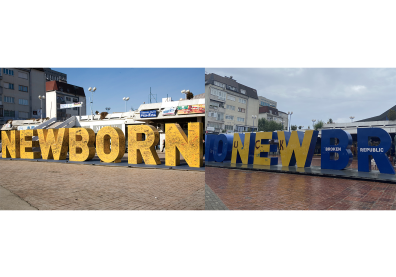
Eighteen years after gaining independence, Kosovo continues to consolidate its statehood within a shifting geopolitical context, characterised by international rivalries, transatlantic differences and relations with Serbia that remain complex, with Serbia thus far fiercely opposed to any recognition.
The recent convictions of four former KLA leaders in The Hague and the reform of the Special Court – contested by Brussels – are reigniting tensions between the expectations of Kosovar society, the country’s international commitments and its European ambitions, whilst also raising the risk of Pristina drifting apart from its European partners. Alexandre Vučić’s historic defeat in Serbia in the parliamentary elections on 25 October, on the other hand, offers hope for a resumption of dialogue between Belgrade and Pristina.
Beyond these political issues, the social and economic transformations – to which the diasporas, citizen mobilisations and protest movements contribute – also invite us to understand Kosovo and regional dynamics ‘from the bottom up’.
The Observatory on Contemporary Central Europe
The Observatory on Contemporary Central Europe at the Centre for Research on Europe and Eurasia (CREE), INALCO, aims to organise debates open to the general public, bringing together specialists (academics, experts, journalists, diplomats…) from the states and societies of Central Europe, to provide contextualised insights into current affairs and to examine how the civilian populations of this region perceive the political and social changes or phenomena that are the subject of debate. Whilst addressing current affairs, the Central Europe Observatory will also focus on societal issues over a longer time frame (issues relating to domestic politics, and socio-economic, cultural and media developments).
Organisation
- Katerina Kesa (CREE, Inalco)
- Anne Madelain (CREE, Inalco)
- Jana Vargovčíková (CREE, Inalco)